

There's Always Next Year
Being a sports fan in Minnesota is a pretty futile existence. For years the national icon of sporting ineptitude was Boston. They were famous for having to watch their teams choke, year in and year out, as they feebly tried to compete with their big sister to the south, the Big Apple. Yet, within the past seven years, their pro sports teams have garnered a combined six league championships, capped off by the Celtics victory over Kobe Bryant and the Lakers earlier this summer. In the modern era of professional sports, beginning in Minnesota when the Twins and Vikings came to town 47 years ago, the state has won a grand total of two championships in the four major sports put together (Hockey, football, basketball, and baseball). The ultimate irony of the Celtics victory this past June was that it was precipitated by their new all-star forward, Minnesota icon Kevin Garnett, in his first season out of a Timberwolves jersey, after spending his first twelve years with the team. The emotions his victory stirred really epitomize just what it is like to be a fan in the North Star State.
The most recent title brought home by a local team was the Twins World Series victory in 1991. I was three years old and would have been fortunate to know what a baseball was, much less be able to appreciate the Twins victory, or even remember it (which I don't). In the thirteen years since I began following sports I've seen one of my teams make it to their respective championship game just one time, and even then it wasn't a Minnesota team but the Carolina Panthers, who would go on to lose the Super Bowl to the New England Patriots, based in, you guessed it, Boston. Quite frankly, the fans in Beantown, or any other pro sports center other than Minnesota for that matter, can't complain about a darn thing. Minnesotans have the double curse of both living in a small market (relative to their competitors) and being the perpetual champion of chokers, an insurmountable combination, not to mention their frequent affliction of plain old bad luck.
The following seven paragraphs are all detailed descriptions of times when Minnesota teams have suffered agonizingly painful losses due to failure under pressure and bad fortune. So, if you don't feel like reading my incessant whining you may want to skip ahead, but it does provide appropriate context.
First, let's delve into that choking aspect of the game. Case in point number one: January 1999, the NFC Championship Game featuring the Atlanta Falcons vs. the Minnesota Vikings. The Vikings were far and away the best team in the regular season that year finishing with a 15-1 record and breaking the record for most points ever scored in a season. Both of their starting wide receivers, Cris Carter and a rookie named Randy Moss, were future hall of famers. For once their defense, a perrenial weak point, was just as strong as their offense, boasting two of the team's unbelievable ten Pro Bowl selections. Even their special teams were off the charts with kicker Gary Anderson making every single kick, field goal or extra point, the entire regular season, an unheard of feat, and setting the record for most points scored by a kicker in a season. After earning a bye in the first round of the playoffs and cruising over an overacheiving Arizona team in the second round, the Vikings hosted the dark horse Falcons in a battle to go to the Super Bowl. Fans were nervous in the fourth quarter as Minnesota clutched to a one touchdown lead, but when Anderson lined up for a pedestrian 38-yard field goal (I can make a 42-yarder myself, and anything under 40 is generally considered money in the bank for a pro, especially in an indoor stadium like the Metrodome) with two minutes left that would have sealed the game for the Vikes, the masses of Minnesota let out a collective sigh of relief. With Anderson's season, this was a done deal, right? I still remember where I was when this play was taking place. I was on my way over to Owen's house with my dad where we were going to pick him up so he could come over and hang out. As we pulled into his drive way we were listening to the game on the radio. When I heard the situation I almost stopped listening, only to be shaken out of my stupor when the anouncer began yelling that the kick was wide left, grazing the upright. Naturally, because this is Minnesota, the Falcons got the ball back on their own twenty with under two minutes left and proceeded to march down the field and tie the game. The Vikings would lose in over time when the Falcon's kicker made, in perfect irony, a 38-yard field goal. As Owen and I watched the Vikings throw away their season back at my house, I felt like I had to vomit, I was in disbelief, sort of like the time I scored an own goal in soccer. And remember, the Vikings aren't even my favorite football team. The Friday before at school one of the teachers led a march through the hallways, stopping by every classroom and inviting those wearing Purple and Gold to follow him as he got the secretary to loop Will Smith's "I'm going to Miami" over the blaring intercom, since the Super Bowl was to be held in Miami that year. I literally was unable to listen to people talk about the game the following week at school because it was too painful to mentally re-live. The Falcons would go on to get crushed in the Super Bowl by Denver, who was led by a 38-year old John Elway.Two years later the Vikings stormed back to the playoffs with most of the same team intact from their '98 run. They got to the NFC Championship once again, hosted this time by the New York Giants, whom were referred to in the week preceding the game as "The worst team in NFL history to ever win homefield advantage in a conference championship game." The Giants won the cointoss and scored within the first two minutes on their opening drive. The Vikings kick returner fumbled the ensuing kick off, which was recovered by the Giants on the 18 yard line. I could feel a sinking in the pit of my stomach. They scored a touchdown on the next play. It was 14-0 in just over two minutes. I turned off the TV. I wasn't even surprised when I learned later they lost 41-0, the worst loss in a conference championship in league history. It's now known infamously as the "41-Doughnut" game. And as for the Giants? They got destroyed the following week in the Super Bowl by a Trent Dilfer led Baltimore squad.
December 2003: After fielding losing teams in the two seasons following 41-doughnut, the Vikings finally appear to make a climb back to respectability in '03. All they have to do in their final game is beat the Cardinals, year in and year out the worst team in the NFL, and they clinch a playoff spot. Of course they make it unnecessarily close, but things still appear to be safe. The Cards, losing by less than a touchdown, are down to their last play. Their unknown Quarterback lobs the ball forty yards into a pile of bodies in the endzone. Nathan Poole, a no-name rookie, leaps out of the crowd and snatches the ball. The Vikings' defenders push him out of bounds before his feet touch the ground, this is ruled a penalty. Cardinals Win. As I watched it seemed inevitable, it was simply too perfect a choking opportunity for the Vikes to pass up. I remember being extremely thankful I had the Panthers to root for. Over in Wisconsin the arch-rival Packers seal a victory over the Bronco's second string. When they hear the Vikings have lost, pandemonium erupts in Green Bay as this has launched the Pack into the playoffs. Nathan Poole is awarded the key to the city of Green Bay. When they finally did make the playoffs again the next year, it was because the Panthers were upset in the final game of the regular season, much to my chagrin, vaulting the Vikings ahead of them even though they only had an 8-8 record and had lost their last game too, to lowly Washington. My Panthers had out-choked the Vikes.
The following season they would bottom out with the love boat scandal, recording two consecutive losing years before breaking even at 8-8 this past season, but losing once again to Washington in the final weeks to miss out on the playoffs this time around.
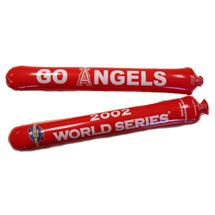
October 2002: The American League Championships Series boasting the Minnesota Twins against the Anaheim Angels. After a straight decade of losing following their '91 World Series victory the Twins were finally back in the playoffs. In a fantastically close Divisional round the Twins edged out Oakland and appeared to be headed to the World Series when the Angels upset the annual favorites, the New York Yankees in the same round. They trounced the Angels in the first game. Only to be blown out in the next four consecutively, taunted by Anaheim's new mascot, the adorable "Rally Monkey" and those noise polluting Thunder Stix.

Four years later the Twins were making a miracle run to the playoffs. It was just after my graduation and when I left for Germany the Twins were in a distant second (maybe even 3rd?) place, and had a solid losing record. In the two weeks I was gone they lost one game. I returned home to find us battling the White Sox for the division, a battle we would ultimately win on the back of MVP Justin Mourneau, Batting Champ Joe Mauer, Gold Glove Winner Torii Hunter, and the incredible pitching stable of Cy Young Winner Johan Santana, Rookie Sensation and All-star Francisco Liriano, and the venerable veteran Brad Radke, who had announced it would be his last season. It seemed perfect. Like the Amazin' Mets of '69. They were the team of destiny, emerging from the doldrums to storm all the way the the championship. Most of the players were unknown, but still managed to win the most prominent awards in the league. Well, mere weeks before the playoffs, Liriano tore a ligament in his elbow, ending his season. The injury was so severe, he just returned to the Twins full time two weeks ago, two full years afterward. Radke began to break down too, as he was receiving cortison shots in his picthing shoulder before each game to relieve the constant inflamation and pain he was enduring there long enough for him to pitch (the reason he said earlier in the summer it would be his last season). The Twins were swept by the Athletics in the first round of the playoffs. The two defining moments for me: 1. In the closest game of the series, legendary defensive star Torii Hunter dives for a ball he couldn't possibly have caught, allowing it to roll past him and bring in the winning run. 2. Radke, knowing his career has just come to and end, in tears as he leaves the mound in the fourth and final game of the series, after being blasted in the first few innings.
Sometimes it seems like this is more of a personal family curse than simply a Minnesota-wide one. I mentioned earlier that the only team I follow closely to ever even make it to a championship game was the NFL's Panthers back in January 2004, when they lost in a hearbreaker to the Patriots in a game remembered more for Janet Jackson's shimmering breast than Muhsin Muhammad's record long touchdown. It goes further than simply the Panthers, Vikings, and Twins though. The Timberwolves have gotten past the first round of the playoffs once since they came into existence 19 years ago. The Gophers football program, awful for the entirety of the 90's, started to work its way back to respectability before suffering the worst come from behind bowl loss in all 100 odd years of college football history in the 2006 season, before dropping to 1-10 last year. The Gophers men's basketball program, in the midst of one of its few dazzling seasons in '98-'99 had their title hopes stripped away when it was revealed the coach had people cheat for the star player so he could pass his classes and they were kicked out of March Madness. The Gophers women's basketball team loses in the final game of the NCAA tournament in 2004. Iowa State football loses one of their first bowl games in decades in late 2001; the Cyclones lose by one point, after their last second field goal attempt is ruled wide left as it sails high over the post. Later ESPN analyzes the kick using computer technology and finds that the kick was actually good. Iowa State men's basketball loses a game deemed one of the worst upsets in NCAA tournament history when they win the two seed and are knocked about by 15th seeded Hampton in the first round after star player Jamaal Tinsley's lay up misses as time expires. Speaking further about March Madness, as far back as I can remember paying attention the Final Four has never ever gone the way I planned. One year when my bracket was finally doing exceptionally well, Kansas lost to Carmello's Orangemen in the final, dropping me from first to fourth, the hightest spot to win no prize. Then came this past year, the first year in recent memory in which I didn't have any money down on a bracket. I did fill out a bracket though just for kicks on facebook. Well, wouldn't you know it but my bracket did fabulous. I was in the top 5% of all entries on facebook and I picked the correct winning team (Kansas again). But all I have to show for it is a forced grin. And last but furthest from least, the Chicago Cubs. My Grandma Lila has been a Cubs fan her entire 86 years of life. The last time the Cubs won the World Series was 14 years before she was born. All the other so-called baseball "curses" have been broken. Three years ago the White Sox broken their 80 plus year slump. Four years ago, the Red Sox shattered the Curse of the Bambino. Five years ago the Cubs should have tamed their Billy Goat. I've become a Cubs fan through my grandma and I was sure they were destined to win it all in the fall of '03. I was sitting in my basement watching game six of the NLCS against the Marlins, as we were taking a break from filming "The Scarlet Letter: Ghettofied" for American Studies, our first movie. The Cubs had a commanding lead and just needed to hold on for two more innings to clinch a World Series trip. If you know anything about pro baseball you know what happened next. Foul ball, Moises Alou runs over to snag it. A fan in glasses leans over to try and catch a souvenier, disrupting Alou and he misses it, infuriated. The Marlins extend the inning, going on to score enough runs to pull ahead and win the game. They win the next game too, and then the World Series.Moving on from the things athletes can control, like performance under pressure, I'll now address those issues out of the players' hands, those institutional barriers that perpetually keep Minnesota out of the winner's circle. Basically, what it comes down to, is money. As previously stated, in terms of pro sports markets, the Twin Cities is a pretty small region, meaning our teams simply don't have the same financial support available in the bigger markets like California or New York, because the potential fan base starts out so much smaller. This is why so many of our teams leave, or threaten to leave, every couple of years. In the NBA the Lakers are one of the most storied and decorated franchises in history. As their name indicates, they started out in Minnesota, as the Minneapolis Lakers, back in the 40's. Even back then they were smashing records, winning title after title behind hall of famer George Mikan, Vern Mikkelsen, and Jim Pollard. Yet despite this enormous sucess, they couldn't bring in enough profit and were shipped out to Los Angeles in 1960. As well, despite being the state of ice hockey, even the home to the US Hockey Hall of Fame, Minnesota couldn't keep its initial pro hockey team, the North Stars, from moving out in the early 90's either. Down in Dallas they've won the Stanley Cup. Our remaining teams, the Timberwolves, Vikings, and Twins, have all threatened to move as well over the past 15 years to booming cultural centers like Portland or Oklahoma City. The state government had to impose an increased sales tax in Hennepin County to fund the Twins new stadium and keep them in the state.
While it's a fairly difficult task to move a whole franchise out of state, it's a much easier thing for individual players to depart. Thus the phenomenon that has branded Minnesota, and other mid level markets like Kansas City, Pittsburgh, or Milwaukee, in essence the minor league farm teams for the larger cities. Ever since the advent of free agency swept through pro sports, coupled with the infamously greedy appetites of the athletes, there's been nothing keeping the star players from departing the state for richer venues. Almost without exception, whenever any player on a Minnesota team has become a star within the last fifteen years, they have left in their prime for a bigger market offering more cash. All-star Doug Mientkiewicz and David Ortiz left the Twins to the World Series winning Boston Red Sox. All-star AJ Pierzynski to the World Series winning White Sox of Chicago. Torii Hunter to the Los Angeles Angels. Johan Santana to the New York Mets. Randy Moss left the Vikings for the Oakland Raiders and then the Super Bowl bound New England Patriots. Stephon Marbury to the New York Knicks, via New Jersey. Sam Cassell to the Los Angeles Clippers and then the champion Boston Celtics. Notice a pattern? It's a vicious cycle almost impossible to break; it's like our only chance at a title is to win within the first season of a player having a break out year becuase by the next year, they'll be gone. (Notice too how some of pro sports biggest curses, the White Sox, Red Sox, and Celtics' title droughts, were all ended by teams prominently featuring these ex-Minnesota stand-outs.) The worst loss of all though was undoubtedly Kevin Garnett's departure last summer to the Celtics, and it was his victory this June that truly inspired this post.
Garnett is one of shrinking number of pro athletes who care about loyalty. The Timberwolves drafted him out of high school, a move considered a huge risk at the time, and Garnett became fiercely loyal to the franchise and the state that took a chance on him. He cried on the team bus for pete's sake when the Wolves traded little known back-up center Dean Garrett who was with the team for one season. Garnett stuck around a little longer, twelve whole seasons in fact, but was unable to bring home a title. Certainly he couldn't do it alone, but ironically what in part prevented the team from bringing in any quality players was his enormous contract, sucking away any spare remaining funds the team might have had. Nonetheless, despite twelve frustrating seasons, during which they only advanced past the first round of the playoffs one time, Kevin gave has absolute all every single day and was committed to staying with the team. Last summer rumors started circulating that the Wolves might trade him, unable to handle his big contract anymore. Garnett was upset, he didn't want to be traded and made this known when potential deals started developing. Finally, he felt betrayed, unwanted by the team that had given everything to. The man who had been in Minnesota longer than I had been paying attention to basketball accepted a trade to Boston in late July of 2007. I heard the news on the radio driving home from work and yelled out loud in protest. It was the most lopsided trade in history, Garnett for seven players. As I explained to my brother a few hours later, the worst part of it was, if the Timberwolves ever, heaven forbid, won a championship while Garnett was still in the league, it would feel completely empty because I would feel so bad for him, the face of the franchise, as he missed out (though I wouldn't have to worry about him for long). And thus, I would be confined to seven or eight more years of not experiencing the blissful excitemnet of a championship, even if Minnesota won. Sort of like Nomar Garciaparra being traded months before the Red Sox won their World Series.
I was there at the Target Center during the first game of the 2007-08 season, the T-wolves first game in 13 years without Garnett. Our most promising young talent, Randy Foye, was appropriately injured, unable to play, and hobbled out to center court with a microphone, dressed in a suit. Green Celtics jerseys labeled with Garnett's name were scattered around the arena. Foye pleaded with the fans to stay with the team through their rebuilding process as they entered "this new era," and thanked us for coming. I started tearing up a little bit. In true home town fashion the team jumped ahead to an unexpected double digit lead before blowing the game in the fourth quarter. I was there too, in early February, when Garnett made his first return to Minnesota since being traded. He was injured as well, but came out to center court before the game in his best suit and waved and waved and waved. It was the loudest applause I've ever witnessed and it must have lasted over two minutes. In his interview with the local media he said he no longer felt much connection to the players, coaches, or front office anymore, the only bonds he still had to Minnesota were to the fans.
His Celtics burst top the top of the league immediately last season, as Garnett turned a team with one of the worst records in the NBA the previous season, into the Eastern Conference's #1 seed. I followed them intently through their playoff run, hoping he could finally get his chance at a title. I watched as he celebrated his championship on TV, belting out the loudest scream he could muster, and muttering "I made it ma, Top of the world," mixed with intermittent sobs and another cry of "Anything is possible!" As soon as he had calmed down enough to be interviewed the first thing he shouted into the microphone was, "This is for everybody in 'Sota." Once again I started tearing up, overwhelmed with emotion. He was talking to me. He was repaying me for the late school-nights I spent watching playoff games til one in the morning instead of doing homework, the hard earned money I'd spent on merchandise and tickets, the years I'd closely followed him and the team, and really every other unfulfilled promise I'd experienced following Minnesota sports. And still, his victory wasn't with the Timberwolves, but that was the best he could do. That's really what Minnesota sports fans have been relegated to, vicariously feeding off the success of other teams' represented by players who used to belong to us. That's the closest we can get to experiencing the true ecstasy of victory. I know many a fan who rooted for the Patriots this past year in the Super Bowl because they still wanted to feel like Randy Moss was playing for them.
And herein lies the apparent paradox of the small market: There may always be a next year, but when next year promises to be the same as last year, does it really matter?
posted by DJDangerRanger @ 12:57 PM


2 Comments:
I believe you are looking for a young Josh McCown throwing that beautiful pass to beat the Vikings.
Ah, I thought that might be the culprit but wasn't sure. In related news, some big magazine announced today that the Twin Cities are one of the ten most miserable sports cities in the US. I rest my case.
Post a Comment
<< Home